You were taught what to believe.
You were never taught how to study.
The Discipline of Scripture is a repeatable framework for understanding any passage of the Bible — with confidence, clarity, and independence.
For generations, believers have received doctrines, devotionals, and sermon summaries. What they did not receive was a method. The 5-Step Starter closes that gap. It is not a commentary. It is not a workbook. It is a way of seeing — a disciplined practice of observing, contextualizing, interpreting, anchoring, and applying Scripture that anyone can learn and no one can take away.
The 5-Step Starter is the entry point into a wider practice — a framework being refined, a discipline being lived, and a growing community of readers learning to study Scripture for themselves.
The first step into the practice · No noise, ever
Lewie Daltrey · Founder
A Note From the Founder
Why The Discipline of Scripture Exists
For most of my Christian life, I mistook consumption for study.
I listened to sermons on the commute. I underlined paragraphs in books written about the Bible. I forwarded snippets, quoted verses I had not sat with, and built convictions on the strength of someone else’s feeling about a passage. I thought I was deepening. I was, in truth, accumulating.
The reckoning was quiet. I opened a familiar passage one morning and realised I did not know how to read it on my own. I knew what others had said about it. I knew what it had made me feel. I did not know what it meant — and I had no method by which to find out.
So I began, slowly, to build one. Five honest questions, asked in order. A practice I could return to with any passage, in any season, without depending on a personality, a platform, or a mood.
The Discipline of Scripture exists for one reason: so that ordinary believers can study the Bible with confidence, independent of the noise.
— Lewie Daltrey
Three Quiet Commitments
Slow Down
Depth is not formed through speed. Read a passage more than once.
Write It Down
Putting answers on the page slows perception and prevents assumptions.
Act On One Thing
Understanding becomes formative only when you respond to it.
A Different Posture
What Makes This Different?
Most resources are built to deliver information — facts to know, opinions to adopt, moments to feel. The Discipline of Scripture is built to form a process. A method you carry into any passage, in any season, for the rest of your reading life.
On Listening & Reading
Traditional Consumption
Receiving insight through sermons, podcasts, and the steady stream of teaching from others.
Disciplined Study
Opening the text personally and working through a passage with your own attention first.
On Forming Conclusions
Traditional Consumption
Arriving at a view by trusting another reader's interpretation of what a passage means.
Disciplined Study
Forming a view from direct observation of what the words actually say, in their own context.
On What Follows
Traditional Consumption
Leaving a passage when it has stirred something — inspired, comforted, convicted.
Disciplined Study
Carrying the passage through to a single, specific response you are willing to live out.
One is not the enemy of the other. But only one of them belongs to you.
The Road Ahead
This Is Only The Beginning
The Discipline of Scripture is not a single product. It is a practice that deepens over a lifetime — and a body of work that grows alongside you.
- I
Free 5-Step Starter
· Available now ·Where the practice begins. A single passage, walked through five honest questions.
- II
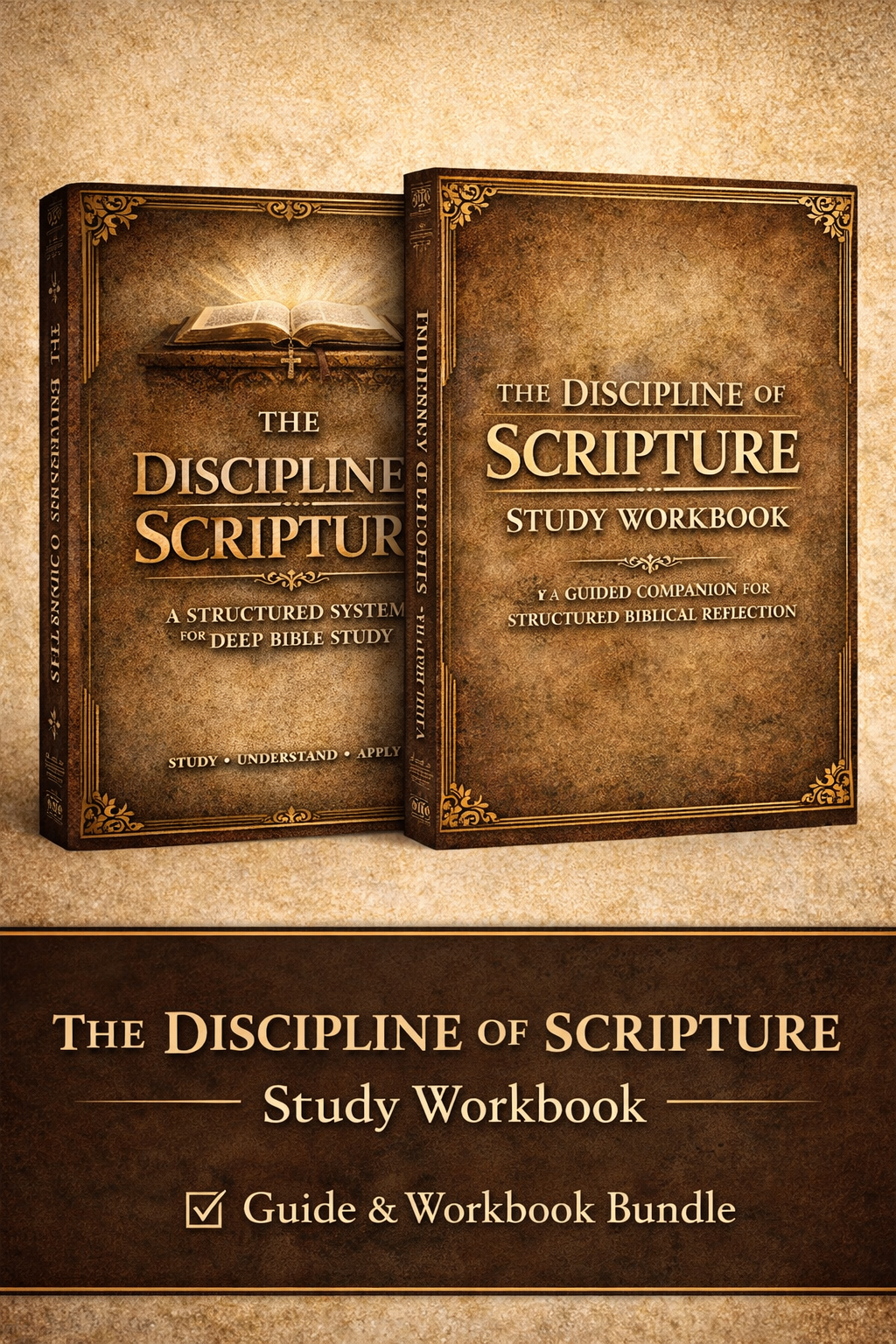
Study Workbook
· In development ·A guided companion for the five steps, with space to write, reflect, and return.
- III
Full Discipline of Scripture System
· In development ·The complete framework, with advanced tools for every genre of Scripture.
- IV
Community
· Coming next ·A circle of readers committed to disciplined study — not discussion for its own sake, but accountability to the text.
- V
Future Resources
· On the horizon ·Courses, seasonal reading plans, and tools that extend the discipline into every corner of your life.
Each step deepens the last. You are not buying a product — you are entering a practice.
The Method
Five steps, in order
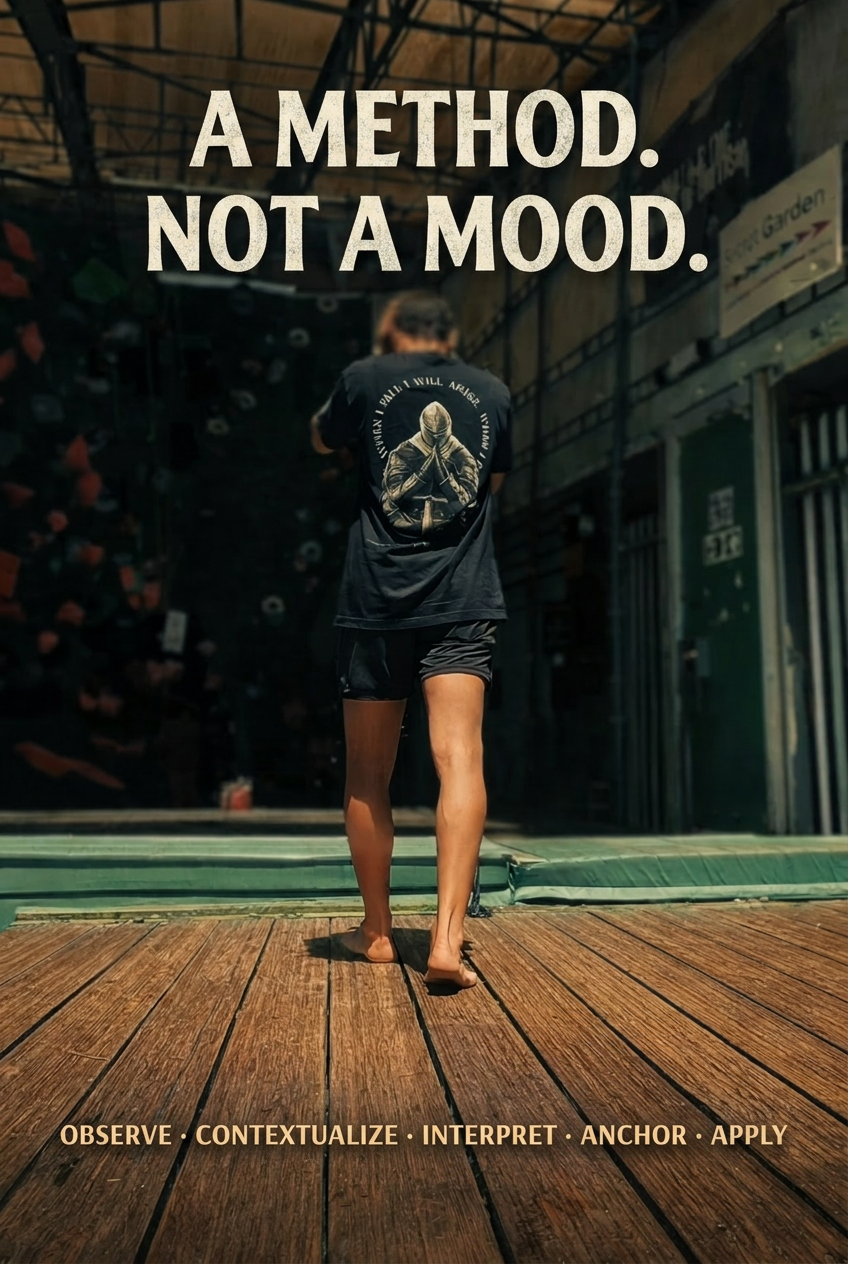
Move through them gently. Each one asks a single, honest question — and the answers build on each other.
- 01
Observe
What is actually here?
Begin with what is plainly written. Who is speaking, who is listening, what words or ideas repeat?
- 02
Contextualize
Where does this sit?
Who wrote it, to whom, and what was happening? A passage always sits inside a larger story.
- 03
Interpret
What does it mean?
Seek the author's intended meaning before your own reflection. Let the text speak on its own terms.
- 04
Anchor
What timeless truth?
What does this reveal about God's character and human nature — truth that outlives the original moment?
- 05
Apply
What changes today?
Where does this invite change? Name one specific, realistic step and take it.
You do not need Greek, a commentary, or a seminary degree — only attention and five honest questions. That is the whole skill.
— From The 5-Step Starter
Where the practice begins
The Starter is the first artefact of a developing body of work — written to be used, not merely read.
The Method
The five questions that form the spine of the discipline — the same framework returned to, passage after passage, for a lifetime.
Watch It Done
A worked example on Philippians 4:6–7. The method shown in motion, the way a craft is learned — by watching it practised.
Now You Try
Your first passage, taken slowly. The beginning of a practice you carry, not a worksheet you finish.
Join the practice.
One framework. One passage at a time.
A discipline you keep for life.